
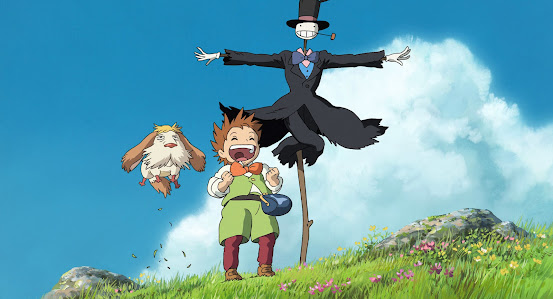
If you were late with your previous entries or feel you need extra credit for whatever reason, comment on either or both of the Extra Credit entries (Hayao Miyazaki, Adventure Time.) The more you do, the more extra credit you accrue.
Post reactions ( minimum 250 words) to the reading linked below. Students are encouraged (but not required) to additionally respond to other student reactions.
"The Fantastic Worlds of Hayao Miyazaki." A new book by Tufts professor Susan Napier analyzes the Japanese anime director’s films—and his life. Click heading to read article.
"Hayao Miyazaki and the Art of Being a Woman" by Gabrielle Bellot. The famed Japanese animator and director created heroines who defied feminine stereotypes and showed me how to be at home in my own skin. Click heading to read article.
"Hayao Miyazaki's 50 Favorite Children's Books." Click heading to review list.
"The Animated Life." New Yorker staff writer Margaret Talbot discusses the animator Hayao Miyazaki’s films, his influences, and his temperament. Click heading to read interview

11 comments:
As someone who has never been intrigued by anime,I found Susan Napier's interview to offer a unique lens in which I was able to appreciate Hayao Miyazaki, not just as an animator, but as a raconteur, who grapples with questions that discuss the problems of modern life. Her most significant insight is how Miyazaki's refusal of easy resolution makes his work more honest than most Western cinema. Where American animation resorts to the “happily-ever-after ending”, Miyazaki allows his characters to part ways, leave things unresolved, and inhabit a world that resists simplicity. That willingness to sit with ambiguity isn't a flaw, it's a profound benefit to young audiences being conditioned to expect perfect outcomes.
Napier's reading of “Kiki's Delivery Service” is particularly interesting as she frames Kiki's loss of flight as a metaphor for depression, which reframes what might seem like a lighthearted children's film into something far more layered. Furthermore, I also found the discussion of his strong female protagonists to be interesting. Rather than inverting gender norms, Miyazaki creates characters like Nausicaä who holds both masculine and feminine traits, resulting in balanced and nuanced figures.
I have watched a lot of Hayao Miyazaki’s films and I’m a huge fan of his work so reading these articles was really interesting to me. Something that stood out to me the most, and sums up why I find myself drawn to his work, is “The Fantastic World of Hayao Miyazaki.” In the interview, Susan Napier mentions how Miyazaki’s movies are not only for children, as he explores heavy themes and topics through fantastical levity. Napier uses the film, “Kiki’s Delivery Service” as an example of this, and it's one of my favorites for this very reason. It uses playful elements like magic, witches, and flying to touch on heavier topics like burnout, making the story very relatable for all ages.
I also really like how Napier mentioned Miyazaki’s portrayal of female protagonists in his films. They are almost always independent, young female characters who often don’t end up with a love interest at the end, instead focusing the story on their self-discovery. I remember reading a quote by Hayao Miyazaki that mentioned how he wanted to write stories that portrayed love in a different way, like platonic love. I found this idea to be truly inspiring because it's something that I feel is important in stories, especially middle grade and young adult, because those other forms of love are what is most present in our daily lives.
- Mia (PinkPowerRanger)
I'm one of Hayao Miyazaki's biggest fans and have quite literally watched all of his movies in order. The first ever movie that introduced me to this work was Ponyo, which was shown in my second-grade class. As Gabrile in the Atlantic described it, she was amazed by the power he gave women. In many of his animations, the main characters are women who are not held back or influenced by their gender. As a little girl, watching another girl my age save the world from an evil marine witch changed my view of the world and my capabilities. I was powerful and unstoppable. As I grew older, so did my understanding of Hayao Miyazaki's other films. To this day, my favorite of his remains Howl's Moving Castle, in which the main character, Sophie, gets cursed by a witch and sets out to break the curse. But the curse of growing older isn't depicted in a negative light, as many other animators might, but rather to find herself again. Being a woman in Miyazaki's world is more of a superpower than a tool for a male audience. I was quite disappointed watching other animations depict women, especially younger girls, in a sexual manner for the male gaze.
-Bibi
I grew up with Hayao Miyazaki's works, which were introduced to me by my mother. I believe it was either Ponyo or Howl's Moving Castle she first showed both me and my brother, often times from a shady facebook link dubbed in Spanish. But I felt such wonder when I watched those films. The bright colors, the expressions, the characters- all of it drew me in. Even though there were fantastical elements in those stories, they still felt grounded in reality. That magic was another facet of life- not something strange or foreign to be gawked out, but harnessed. The narrative focus was and still is different from the types of stories told in America, and I find it quite refreshing given how we seem to be remaking and repeating stories due to capital interest instead of the joy of creating. I think that is why I appreciate his works- I can feel the love and care that went into them, instead of rolling my eyes as the characters dialogue explains even the smallest of details to ensure I know exactly what the authors intended. I like having the chance to dissect a work of myself, and coming to my own conclusions. I hate when stories feel the need to over explain themselves in fear that their writing did not make it clear enough. It comes across as sloppy and I find myself turning away from many books as a result. Film also does that, and it is just as egregious because it doesn't use the art of film to tell the story, and takes the lazy way out. These films allow me to think, and process what I'm seeing without holding my had. I like that, and wish more stories did that.
Something that Susan Napier points out is that Hayao Miyazaki’s movies often deal with complex and more mature themes than western animation does. She views this as important because it allows the audience to grow up with the characters, as well as show respect for their intelligence in storytelling. This is something that I agree with, although I think there are some caveats to it. I think that animated properties having respect for the intelligence and maturity of their audiences is hugely important, while at the same time, I do not think it is entirely necessary for every animated piece of media to be constantly dealing with mature and heavy topics. Sometimes, a simpler and less complex theme could stick with a kid just as much as a heavy and mature topic. Another important thing that Napier pointed out are the “villains” in Miyazaki’s movies. The villains in Miyazaki’s films are not always the prototypical villains you would think of in western animation. The villains often have a lot of depth, some you are able to see the good in while still acknowledging that their actions are wrong. I think that this is a very important thing to have not just in animated stories, but in every kind of story. If we do not understand why the villain is the way they are, what good are they? We should have something of an understanding of what the villain wants and the why behind that. I have to respect Miyazaki’s commitment to this. As Margaret Talbolt pointed out, he is an extreme workaholic with extreme dedication to his craft. His life largely revolves around these stories, allowing him to flourish in that regard.
Amber/Gremlin: Like most people in my age demographic, I have a love for Miyazaki’s work. I have a decently sized No Face tattoo on my arm, if anyone was dubious of my Ghibli cred. I feel like it’s almost difficult to comment on Myazaki’s work, because so much has been said about the wonderful worlds he’s created already. I find it difficult to add anything new to the discussion.
I found the first article’s interest in Miyazaki’s comfort including ambiguity in the relationships with his characters fascinating. When thinking about the semi-romantic relationship between Chihiro and Haku in the way the first article presents them, I fell in even deeper love with the story. One of the many, many things people love about Miyazaki films is that the characters’ experiences are deeply relatable despite their fantastical foundation. The article mentions how their storyline is “unresolved” in a way, and they part for good by the end of the story. As an adult viewer who has had a plethora of relationships dissolve for good, I found that observation to be particularly impactful for me.
I also really love the way Miyazaki portrays women, especially girls. I didn’t start watching Miyazaki films until I was a young adult. Therefore, I have no nostalgic feelings when watching his films. However, stories like Spirited Away, Kiki’s Delivery Service, and My Neighbor Totoro have definitely had a healing effect on my inner child. I find their complexity really refreshing in a world where many female characters can be overlooked or one dimensional.
As someone who grew up on Hayao Miyazaki's films, it was so so fun to read "Hayao Miyazaki and the Art of Being a Woman" because YES!!! One of my favorite movies growing up was Nausicaa of the Valley of the Wind and Princess Mononoke, and oh, how much I love being a woman because of it. All of the young girls that were in his films that were my age at the time of watching (Spirited Away, Whisper of the Heart, My Neighbor Totoro, Kiki's Delivery Service) were also incredibly human and real. Despite being kids, they were so adventurous and curious in a way that I believe only a young girl could be now that I'm older and looking back. I loved being curious about the stupid little things in hopes it lead to an adventure because of it when I was young, and I believe it's stuck with me until now as well. The wonder and whimsy in his films is something I hope to also have in my writing and stories. It's like this nostalgic longing for something wondrous.
-lizard
I read the article "The Fantastic Worlds of Hayao Miyazaki." I found it really interesting to read about how Miyazaki's films were changed for American audiences. I remember seeing the ending scene of Spirited Away when I watched it as a kid, and it really felt like a typical Disney movie ending, where the main character has learned a major life lesson that they will take with them into the future. I had no idea that there was an original version of this scene that ended in a more ambiguous way. I feel like this makes the movie much more interesting and less concrete. Just because Chihiro had an adventure that changed her life doesn't mean that her life will be perfect from then on; real life is much more complex than the Disney movie template.
I also thought it was interesting that anime became more popular in the United States after 9/11, likely because of this ambiguity. I haven't watched much anime myself, but I get the sense that it offers a very different outlook on life from a lot of US media. I definitely remember feeling like Spirited Away was nothing like I'd ever seen before. I also appreciate that Miyazaki includes many female protagonists in his works– the fact that his female characters are just people with both traditionally male and female characteristics makes his movies a refreshing change from the strict gender roles of most US movies. It's incredibly important for girls to have representation in movies outside of being framed as simply a love interest, and I think Miyazaki takes a good approach to creating well-rounded female characters.
Reading “Castles in the Air” gave me a deeper appreciation for Hayao Miyazaki and the amount of thought and emotion behind his films. One thing that stood out to me was how the article described Miyazaki as someone who is deeply critical of modern society, especially how technology and consumer culture disconnect people from nature and imagination. I found that interesting because those concerns appear so clearly in many of his movies, especially Princess Mononoke, Nausicaä of the Valley of the Wind, and Spirited Away. The article helped me understand that his fantasy worlds are not just creative settings, but reflections of his personal beliefs and worries about the real world.
I also liked how the article explained Miyazaki’s attention to detail and his dedication to animation. It was surprising to read about how intensely he works and how carefully he thinks about even the smallest scenes or character movements. That level of care probably explains why his films feel so emotional and immersive compared to many other animated movies. The article emphasized that Miyazaki’s stories are not built around simple villains or predictable endings, which is something I really admire about his work. His films often focus more on human emotions, relationships, and moral complexity.
Another part I found meaningful was the discussion about childhood and imagination. Miyazaki seems to believe that children experience emotions in a very real and honest way, and his films capture that perspective without talking down to younger audiences. Overall, “Castles in the Air” showed me why Miyazaki is considered such an influential filmmaker. His movies combine beautiful animation with serious themes about humanity, nature, and imagination, which makes them meaningful for both children and adults.
Post a Comment