
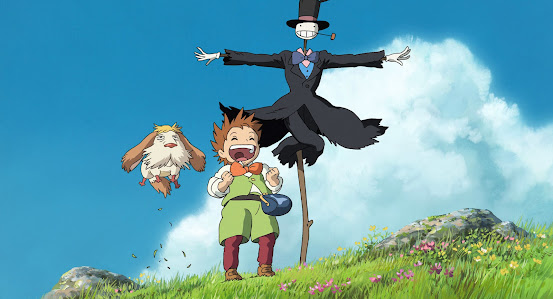
If you were late with your previous entries or feel you need extra credit for whatever reason, comment on either or both of the Extra Credit entries (Hayao Miyazaki, Adventure Time.) The more you do, the more extra credit you accrue.
Post reactions ( minimum 250 words) to the reading linked below. Students are encouraged (but not required) to additionally respond to other student reactions.
"The Fantastic Worlds of Hayao Miyazaki." A new book by Tufts professor Susan Napier analyzes the Japanese anime director’s films—and his life. Click heading to read article.
"Hayao Miyazaki and the Art of Being a Woman" by Gabrielle Bellot. The famed Japanese animator and director created heroines who defied feminine stereotypes and showed me how to be at home in my own skin. Click heading to read article.
"Hayao Miyazaki's 50 Favorite Children's Books." Click heading to review list.
"The Animated Life." New Yorker staff writer Margaret Talbot discusses the animator Hayao Miyazaki’s films, his influences, and his temperament. Click heading to read interview

4 comments:
Something that struck me was the fact Miyazaki doesn’t want children viewing his movies more than once a year, which at first feels counter-productive (at least in a capitalist based society’s lens) but his perspective makes a lot of sense and it’s really profound especially given how technology has advanced in two decades. It’s also really interesting how Miyazaki does differ from a lot of his contemporaries, as someone who grew up watching anime, it was very flashy and loud, it was made to grab kids’ attention and hook them on. But after having watched Miyazaki's “Howl’s Moving Castle” it really was different because of how mellow and warm it felt. It was never in your face to an egregious extent, but it was still riddled with details. Comparing his work to British fantasy writers does make a lot of sense, in the way it feels so realistic. I do think it’s interesting that two movies she stated aren’t for young kids, because it touches on the whole idea of what exactly is “children’s media”, I have no opinion on the movies since I haven’t watched it but I do know he retains his signature art style which is a very interesting and earnest move on his part. It’s also very interesting how much one’s childhood can influence their work in a plethora of ways as Miyazaki had a fascination with airplanes and British fantasy, both seem to have influenced his work greatly. I think it really comes full circle, him creating media for children which is based on elements he was fascinated with growing up. I do agree that we as a society are dependent on virtual reality and subscribe to it without even truly knowing how it impacts the world, but I also believe humans have always been dependent on fantasy. Not negating Miyazaki’s point, but just kinda looking at it from a perspective of humans continuously trying to be submerged with concepts that are out there.
Yuri / Lei:
I am a huge fan of Studio Ghibli, so Hayao Miyazaki is someone I deeply admire. However, at least in my case, he is one of those people with whom you become incredibly familiar through their works, not their person. My father is very in touch with anime movies and shows, and as such, I grew up watching a lot of Japanese animation. Movies like Ponyo, Spirited Away, and My Neighbor Totoro are all films that shaped my personality in my youth and continue to do so in my adulthood. After reading about Miyazaki’s inspirations and goals as a filmmaker through Professor Napier, I realized that I am more familiar with Miyazaki than I thought, or rather, there seems to be a reason why I was so drawn to his works. I never really realized how many of his movies seemed to focus on women, and I am struck by just how well he was able to curate their character without simultaneously tearing them down. I suppose those intricacies aren’t really things you notice in your youth, but they did subconsciously create a standard of expectation in my head for other filmmakers and how they handled their female characters. Not only this, but I was also extremely delighted to see some of my favorite books in his top 50 children’s books list. The Hobbit, Treasure Island, and When Marnie Was There are all books that I have thoroughly enjoyed, and, looking back, I can absolutely see how they have inspired Miyazaki throughout his creative process (not to mention When Marnie Was There was made into a movie by the Studio), especially in how he curates relationships. Overall, I was very thrilled to read more about one of my favorite filmmakers!
This was Yaoi!
Natalie (aka Miles)
The articles in the blog post above are all evaluating the filmography of Hayao Miyazaki. He has directed several films all with astonishing soundtracks, beautifully vibrant animation and eloquent dialogue. His films consistently stand out as masterful artistic productions. Yet, they are also exceedingly notable for their presentation of deeply poignant themes and impactful storylines. In the article "Hayao Miyazaki and The Art of Being A Woman", author Gabrielle Bellot explains the larger personal and societal impact that the innovative director's work has had. Bellot explains that the female characters Miyazaki had not only created but celebrated within his films were trailblazers and extremely important in breaking down patriarchal, anti-feminist stereotypes in film and media. Miyazaki portrayed his female characters as having equal positions of power to their male counterparts, as protagonists, and had them act in dynamic, less traditional ways. Factors that Bellot credits as having influenced her own perception of self, the binaries of gender and the possibilities that come with not having to abide by a specific expectation of how to be. The notion of just wanting to be who you want to be and not having to be a certain way because that is just what has always been done and/or that is what society instructs. The fact that this perspective is a theme that consistently appears across Miyazaki's work is a common point highlighted consistently in each of the articles and a philosophy I greatly appreciate. The director's goal was to create animations for children and family demographics; however, his work had a much larger influence because of his unique ability to celebrate characters (and in turn audience members who see themselves in said characters) as who they are and interpret themselves to be.
Post a Comment